Construction Manager vs. Design Reviewer: Understanding the Difference & Why Both Matter
Authored by Daniel Heukrath, AIA, NCARB, LEED AP
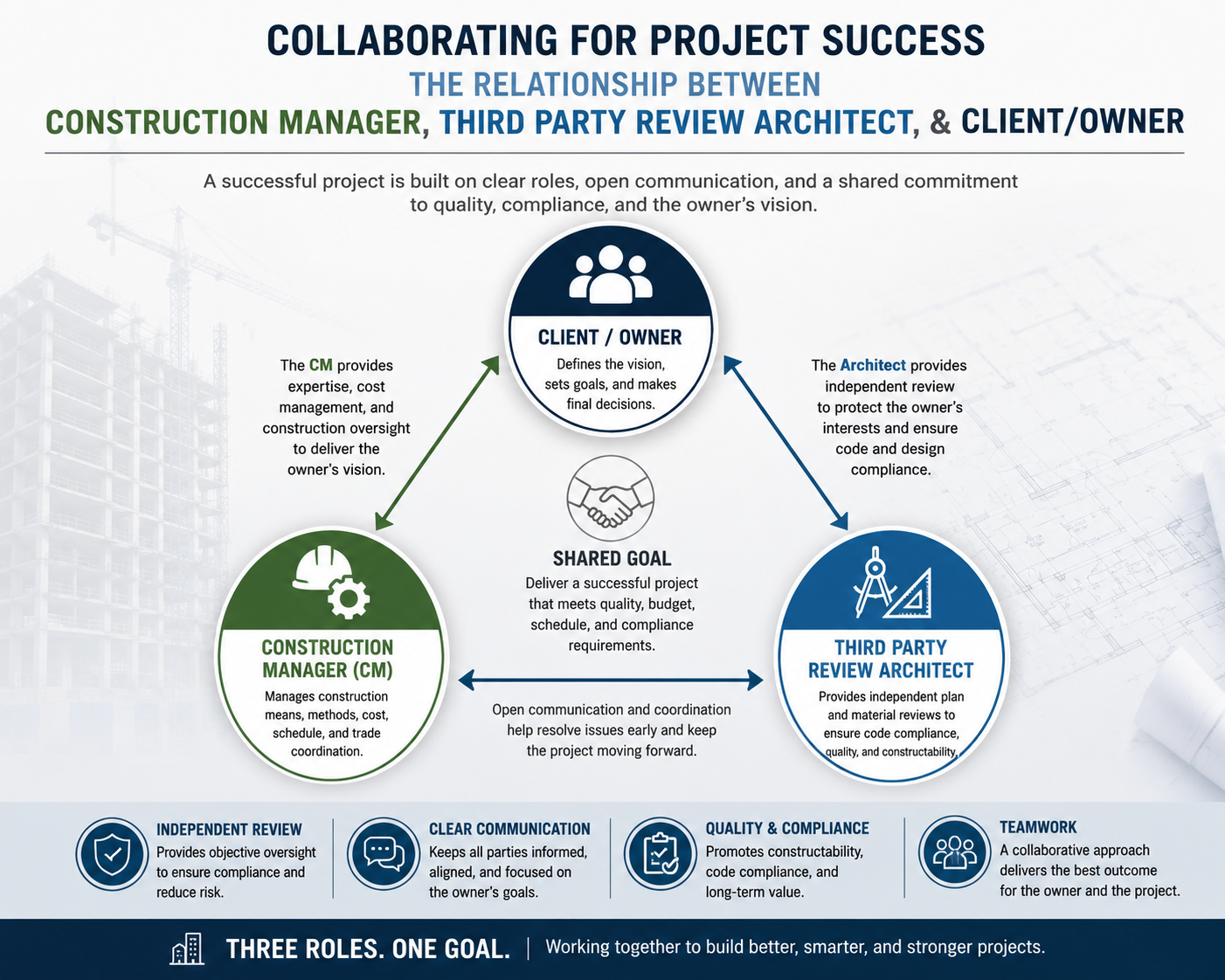
School districts, colleges, and public agencies often engage a Construction Manager (CM) to help oversee project delivery, budgets, and schedules. However, many owners are less familiar with the role of an independent design reviewer or Third-Party Review (TPR) architect and the unique value they bring to a project.
While both contribute to project success, they serve very different purposes. A Construction Manager oversees project delivery, while a Third-Party Review architect evaluates the design to identify potential issues before construction begins. Understanding the distinction can help owners reduce risk, improve building quality, and protect their long-term investment.
Construction Management & Design Review - Different Roles, Shared Goals:
At a high level, a Construction Manager focuses on how a project is built. A Third-Party Design Reviewer focuses on what is being built and whether the design will perform as intended.
The CM's primary responsibilities typically include:
Monitoring project schedules and milestones
Reviewing construction costs and budgets
Evaluating constructability and sequencing
Coordinating contractors and project stakeholders
Tracking progress and mitigating construction-related risks
Assisting with procurement and bidding processes
These services help keep projects on track, on budget, and moving efficiently through construction.
A third-party architectural reviewer, on the other hand, evaluates the design itself to identify potential issues before they become costly problems in the field. This independent review focuses on design quality, performance, code compliance, and the owner's long-term interests.
What Does an Architectural Peer Review Evaluate?
A comprehensive design review looks beyond constructability to determine whether the proposed design will meet operational, maintenance, and performance expectations throughout the facility's lifecycle.
Key areas of review often include:
Building Envelope Performance
The building envelope is one of the most critical systems affecting durability and occupant comfort. A design review may assess:
Water infiltration resistance
Air barrier continuity
Thermal performance and energy efficiency
Roof and wall system detailing
Building envelopes, resilience, and longevity
Early identification of potential vulnerabilities can help prevent future moisture intrusion, deterioration, and costly repairs.
Moisture Management & Durability
Moisture-related failures remain one of the leading causes of building performance issues. Independent reviewers examine:
Drainage strategies
Vapor control approaches
Material compatibility
Detailing at transitions and penetrations
Long-term durability considerations
These evaluations help minimize future maintenance challenges and protect facility investments.
System Maintainability
A design may meet minimum code requirements yet still create operational challenges for facility staff. Design reviews often evaluate:
Accessibility for maintenance
Equipment replacement pathways
Service clearances
Long-term operational efficiency
Facility staff usability
This perspective helps owners avoid inheriting difficult-to-maintain systems.
Commissioning Readiness
Many performance issues arise not from poor construction, but from systems that were not adequately coordinated or prepared for commissioning. Independent reviewers can assess whether:
Systems are properly coordinated
Performance requirements are clearly documented
Testing and commissioning requirements are sufficiently defined
Design intent can be effectively verified during construction
Regulatory and SED compliance
For educational facilities, compliance with applicable regulations is critical. Design reviews can provide an additional layer of assurance regarding alignment with:
New York State Education Department (SED) requirements
Building codes and accessibility standards
Energy code requirements
Industry best practices
Why Owners Benefit from Both Perspectives
A Construction Manager and an independent design reviewer are not redundant services; they are complementary.
The CM helps ensure the project is delivered efficiently, while the design reviewer helps ensure the final facility performs as intended.
Consider the difference:
Construction Manager Third-Party Architectural Reviewer
Focuses on schedule and budget Focuses on design quality and performance
Reviews constructability Reviews functionality and maintainability
Coordinates project execution Evaluates design intent and outcomes
Helps manage construction risk Helps reduce design and lifecycle risk
Protects project delivery objectives Protects long-term owner interests
When both perspectives are incorporated, owners gain greater confidence that projects will not only be delivered successfully but will also provide lasting value for decades to come.
An Added Layer of Protection
Educational and public agency facilities represent significant continuous long-term investments. Decisions made during design can impactmaintenance costs, energy performance, occupant comfort, and building longevity for years after construction is complete.
Independent architectural peer review provides owners with an objective assessment focused on performance, resilience, and operational success, complementing the Construction Manager's focus on project execution.
In summary, together, these services create a more comprehensive quality assurance approach that helps safeguard both the construction process and the facility's future performance.